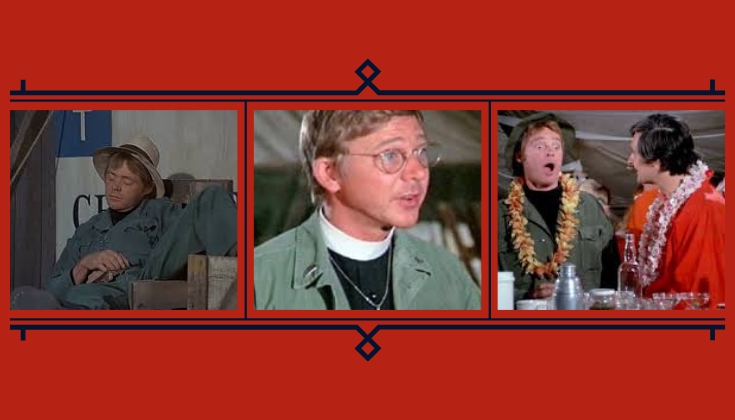
Many of you reading this may not be familiar with this legendary comedian and actor. When I was growing up, in the 1970s, he was a huge star in stand-up comedy. I saw him so many times on the Tonight Show and elsewhere. He sold tons of comedy albums. And, believe it or not, his special was the very first HBO comedy special, way back in 1975. In reality, then, most of that wouldn’t have happened if he had taken the offer that was given to him by the producers of the new television adaptation of the MASH novel and film: the role of Trapper John McIntyre.

Robert Klein was offered the role of Dr. Trapper John McIntyre in 1972 and he turned it down to focus on his standup comedy career, where he achieved great success. Klein stated that the role was not right for him. It’s hard to imagine how different the show would have been if Klein had taken the offer, and how different his career might have been.
Of course, the rest is history, as they say. Wayne Rogers, who initially was tested for the role of Hawkeye, decided to go for the role of Trapper John instead. And legions of MASH fans are glad he did. Robert Klein went on to become a huge comedy star and later transitioned into acting, where he also achieved great success, including many iconic roles. If Klein had accepted the MASH offer, chances are, both his acting career and comedy career would have been less significant, yet, he would have been involved in, in my opinion, the most important project of his career. What would have happened beyond that, we cannot possibly know.

Why Did The MASH Producers Want to Cast Robert Klein?
The MASH producers wanted to cast Robert Klein because they thought that a well-known comic would boost the show’s chances of achieving high ratings and popularity. But, Robert Klein wasn’t the only actor who was considered, and Wayne Rogers wasn’t the first actor to come along after Klein refused.
According to Burt Metcalfe, who was in charge of casting for the show, most of the actors were chosen very quickly. In fact, Metcalfe stated he wanted a “Larry Linville” type for the role of Frank Burns and someone suggested, “How about Larry Linville?” What a great idea! It is also claimed that F Troop star Forrest Tucker was considered for Frank Burns, but Metcalfe maintained his ideal choice was always Linville.
Other notable actors were also considered for the role of Hawkeye, but after zeroing in on Alan Alda, there was no other choice: He was just too perfect for the role.
Another very famous actor is rumored to have been considered for the role of Hawkeye, the Bandit himself, Burt Reynolds. He was quite well-known from television at that point, but this was before he achieved superstardom with Smokey and the Bandit (1977). It is unclear whether the public was already aware of his breakthrough role in Deliverance (1972), assuming that the rumor about MASH is true. While Reynolds could certainly portray the wit, sarcasm, and humor of Hawkeye, he could never have matched Alan Alda’s emotional sensibility, not to mention his intelligence. There may be a connection between the MASH producer’s being attracted to Alan Alda’s acting and Robert Klein, as the two starred on Broadway together in 1966 in a production of The Apple Tree.
But before Wayne Rogers was finally given the role of Trapper, hundreds of actors were considered. It seems that Tapper was the hardest of all the MASH characters to cast.
One thing that might have been different if Robert Klein had taken the role of Trapper John instead of Wayne Rogers is the length of his stay. Wayne Rogers, who didn’t like the language of the contract, never actually signed one. Rogers particularly objected to the “morals clause” of the contract, which he felt was an antiquated attempt to control an actor’s behavior. How his non-signing of the contract slipped through the cracks is anybody’s guess, but this allowed him to leave MASH at the end of the third season without violating his contract. This is not to say that there were not legal remedies. The MASH producers did indeed try to sue the actor for breach of contract, but ran up against the fact that he had never signed one. Would Robert Klein have signed his contract? I’d venture to guess that the answer is yes.

Robert Klein’s Career Without MASH
Robert Klein did just fine for himself without taking the role of Trapper John. He won two Grammys for Best Comedy Album for both of his first two albums. He hosted Saturday Night Live in its first season, returning in the third season.
In 1979, Klein appeared in Neil Simon’s They’re Playing Our Song, winning a Tony Award for Best Actor in a Musical for his portrayal of Vernon Gersch. He also had his own show in the 1980s, the Robert Klein Show, which aired from 1986 to 1988.
His other roles include The Owl and the Pussycat (1970), Hooper (1978), Radioland Murders (1994), One Fine Day (1996), Primary Colors (1998), Primary Colors (1998), The Safety of Objects (2001), Two Weeks Notice (2002), How to Lose a Guy in 10 Days (2003), and Reign Over Me (2007), as well as numerous other roles in film and television.
Robert Klein’s most well-known comedy bit was “I Can’t Stop My Leg” where he pretended to be a juiced-up blues musician who bounced his leg up and down uncontrollably, singing, “I can’t stop my leg.” It’s a pretty good blues song, actually.